Sunday, April 19, 2015

70th anniversary

In just three days we leave for Murnau, Germany, to celebrate the 70th anniversary of the liberation of a prisoner of war camp that held several thousand Polish officers during World War II. We will attend because, when that camp was liberated, my father was there.

Troop B, 116th Squadron, 101st Cavalry and Combat Command A of the 12th Armored Division of the 7th Army are officially recognized as liberating Oflag VII-A at 4:55 p.m., April 29, 1945. Members of Troop B were out in front of the 12th Armored Division, doing reconnaissance on the way to Austria. At around 3:00 in the afternoon, they approached the camp. As the Americans arrived from the north, a small group of SS were coming from the south. They met just outside the camp, and a fight erupted. Two members of the SS were killed, as prisoners climbed the fence and cheered on the Americans.

This commemoration feels as much like a reunion as anything else. Not everyone attending is a stranger to me--although we've never met in person. For example, Martin Lohmann, one of the organizers, and I have been  emailing back and forth for more than a year, and Tom Wodzinski, whose father was a prisoner in the camp, sent me his father's story at least three years ago and is now helping get the names of all the prisoners listed on my website.

Most attendees probably will be the children and grandchildren of the Polish prisoners, but a few descendents of American soldiers will be there. As far as I know, no men from B Troop will attend--the youngest are now in their late 80s--but I continue to hope. I interviewed several members of B Troop--2nd Lt. Joseph Borkowski, Frederick Altizer, Charles Covey, Clinton Thompson, and Lou Gergley--and my memories of those conversations are precious. And I was lucky to also hear Roy Ramuar's and Charlie Kashuba's stories from their families.

I often wonder what my dad would think of all this. I like to think he'd be honored, but, knowing my dad, he'd be just as likely to say I was crazy for making a 5,000-mile trip to the other side of the globe for day of commemoration. He never discussed the war, so I can't say for sure how he would feel. But I'll take his photo, along with photos of other Troop B members, and, as we tour the camp and hear speakers talk about what happened in 1945, I will feel my father close to me. And that is worth a journey of any length.

Sunday, February 8, 2015

Five thousand names

I'm sitting in my office today, entering another 20 to 30 names of Polish officers and enlisted men who were held in Oflag VII-A in Murnau, Germany, during World War II. I struggle with the Polish spellings, but I did discover that creating keyboard shortcuts for Polish letters
not found in English was easier than expected. Just a few of today's names (and their ranks, which are in German) are:
Schütze Marian Konisiewicz, 4.10.1907, worker in Moosburg
Feldwebel Stanisław Judziński, 12.4.1896 aktir, sanitar
Feldwebel Jan Kołacz, 10.3.1899, schofeur
Feldwebel Adam Oligórski, 3.3.1896, hausbegitzer
Feldwebel Władysław Pałka, 11.2.1898, schmidt
Unterfeldwebel Czesłwan Adamczyk, 8.3.1913, schneider
Unterfeldwebel Sylwester Budzynski, 21.12.1908, aktir
Unterfeldwebel Marcin Burzyński, 23.10.1904, aktir-schofeur
Unterfeldwebel Edward Gałkowski, 30.7.1908, sanität
Unterfeldwebel Antoni Garasiński, 6.8.1906, schuster
Unterfeldwebel Marian Grabowski, 23.6.1896, mason
Unterfeldwebel Roman Przybylski, 30.7.1898, tapezir
Unterfeldwebel Piotr Twardo, 29.6.1905, dersicherungagent (or tersicherungagent)
Unterfeldwebel Leor Zielke, 15.4.1910, accountant
Unteroffizier Kazimierz Beśko, 26.8.1910, farmer
Unteroffizier (marine) Jan Bieńkowski, 23.6.1913, eisenb--(indecipherable) This name was crossed out with a word written above it in pencil. It was difficult to read, but looked like "entlanberg.")
Unteroffizier Henryk Bilski, 30.7.1914, fleischer
Unteroffizier Franciszek Boryczka, 16.9.1903, aktir
Unteroffizier Jan Bujnowski, 7.2.1909, schneider
Copying  the  records


Gefreiter Stanisław Gawronski, 24.10.1909, farmer
More than 5,000 men were imprisoned at Oflag VII-Aa lot of namesespecially at 20 to 30 a day. Most of the men whose names I have entered so far were born between 1896 and 1915around the same time as my grandparents.

The numbers following the men's names are their birthdates, which I have left in the same order as in the records: date, month, and year. Their occupations were in German, and, in a few cases, I have attempted to translate them. I finally gave up, deciding that accurate German was better than inaccurate English.

The documents listing these names are housed at the Pilsudski Institute in New York City. Megan Suttles and her friend, Jason (whose last name I regrettably do not know), spent a couple of hours there photographing the documents for meand for the descendants of these prisoners. They photoraphed more than 600 pages, making it easier for those descendants  to learn a little more about the service of their grandfathers and fathers.

I wonder, sometimes, why I am doing this. I could be doing something else today; I don't do it out of boredom. Why spend an afternoon straining to read a list of names written by a German soldier bent over a desk somewhere in Bavaria more than 70 years ago. Our only connection comes from a few short minutes on April 29, 1945, when my father's platoon from Troop B, 116th regiment, 101st Cavalry, happened by Oflag VII-A on the way to Innsbruck. They are credited with the camp's liberation. But, for whatever reason, I am compelled to do it. It seems important that I do.

Pilsudski Institute


Sunday, August 24, 2014

World War II remembered in Murnau

When my son Ted and I visited Murnau am Staffelsee in March 2006, snow still covered the ground and ice rimmed the lake. We walked on a few of trails outside of town and spent the late afternoon sitting at a chilly sidewalk cafe, eating cake, and people watching.
A religious sculpture by
Lt. Kazimierz Artamowski

Photo used with permission 
of Martin Lohmann

We were there because Troop B, 116th Squadron, my father's troop in the 101st Cavalry, had traveled through Murnau on their way to Austria on April 29, 1945, one day before Hitler committed suicide and less than a week before the war ended. Around 3:00 p.m. that day, they passed Oflag VII-A, a camp imprisoning thousands of Polish officers. As the Americans passed the camp, they were approached by a group of SS coming from the opposite direction. The two groups met right outside the camp gate. After a short exchange of fire, two members of the SS were killed and one prisoner who was struck by a stray bullet. According to the records of the 116th squadron, the first of the Americans to enter the camp was Corporal Richard Pawlowski of Chicago, who spoke Polish.

A U.S. helmet found in the region.
Photo used with permission 
of Martin Lohmann
Ted and I couldn't visit the camp, now an active German army base, nor did we see any signs of World War II when we were there. But that is only because we didn't know Martin Lohmann at that time. For several years, he and students in his history class have been collecting information about the camp, as well as photos and other artifacts. Martin is currently writing a book about Oflag VII-A and organizing a 70th anniversary celebration for April 24, 2015. The anniversary will include an opportunity to tour the camp, some of which is much the same as it was in 1945.

It's not the only event he has organized lately. From February 10 to 23 this year, he and his students held an exhibition in the local museum about the end of the war in their area. It included several rooms with military artifacts, either found in the ground or given to the exhibition by veterans. Some of the artifacts included posters, maps, photos, war diaries, and a completely rebuilt air-raid shelter with sounds of an actual bomb raid. One room was set aside for information about Oflag VII-A. More than 1,000 visitors came to see the exhibit.

As he prepares for the 70th anniversary celebration, Martin is seeking more artifacts, as well as first-person accounts from the camp and its liberation. If you have anything you might be willing to share with him to help complete the story of Oflag VII-A, you may email him directly. 
Oflag Room C (the "sergeant" represents Unteroffizier Bartsch,
who was in charge of the camp). The typewriter is original. Martin
has noted that the picture on the wall that is turned backwards
is a portrait of Hitler. It was required to hang it in every office in
the highest position; however, Martin said, they didn't find it
appropriate to have him facing the visitors. 

Photo used with permission of Martin Lohmann


Friday, July 25, 2014

Celebrate the liberation of OFLAG-VII

Martin Lohmann teaches English and history at Staffelsee-Gymnasium in Murnau, a small city in Bavaria. The odds that he and I would ever just run into each other are probably astronomical, but we did. We ran into each because of a common interest in history, specifically the history of World War II. We both had come to that interest through family members who fought in the war: my father and two of Martin's grandfathers.

“History has always been so much more than a teaching matter to me, with my main focus on World War II," said Martin. "With one of my grandfathers surviving the war with what is commonly referred to as a “million-dollar wound,” and the other taking part in all the main theatres of war, but only narrowly escaping death on at least three occasions, plenty of innocent interest was triggered in me as a young boy. It was only much later that I acknowledged the terrors that my grandmothers and parents had to endure in the bomb shelters in Hamburg. In the ’80s, older gentlemen with limbs missing were such a common sight that, unfortunately, it took years to realize that this generation has stories to tell that need to be preserved.”

Murnau 2006
Martin began interviewing local war veterans in 2008 and soon realized he was living near a site that needed more research. He passed by Werdenfels Kaserne, a military base in Murnau, quite frequently on his way to a local fast food restaurant.

“You could tell that its architecture revealed a history of more than 70 years,” he said. “It was within one of my extracurricular history seminars in 2008 that one of my students wrote about Oflag-VIIA, also displaying Alain Rempfer’s pictures that he had found online. Ever since, I have become more and more interested in the history of the POW camp, with many hours spent in the local archives and slowly getting into touch with descendants of the Polish officers in held captive there.”

Among the descendants of the Polish officers held captive at Murnau is where our paths crossed. My father's troop was part of the liberation of the camp, and I also had been in touch with the children and grandchildren of the prisoners. At some point, my name turned up on his radar, and he contacted me. 

Martin and his students have been doing some exciting things in Murnau. In February 2014, they held an exhibition about the end of the war in the region, an exhibit which attracted more than 1,000 visitors. One room of the exhibit focused on Oflag-VIIA, with many original exhibits, barred windows, and a uniformed German Unteroffizier doing his paper work, the originals of which were on display as well.

“There was a lot of positive feedback on the exhibition and many residents praised us for dealing with a topic that had been ignored for almost 70 years,” said Martin. “It is only now that Murnau starts working on its National Socialist past, and I am proud to do my part in this effort.”

Now Martin is organizing a celebration for the weekend of April 24-26, 2015, (exact date of the event will be determined soon) commemorating the Oflag’s liberation 70 years ago. Both the date and the program have been approved by, and are strongly supported by, the Polish consul, the Murnau town hall and the mayor, the army commander of Werdenfels Kaserne, the archive, and the principal of Staffelsee-Gymnasium Murnau.

Martin is hoping that some surviving Polish officers and U.S. soldiers who were present at the liberation will be in attendance at the celebration, as well as their descendants.

“We are very much looking forward to receiving our guests of honor,” he said. “Those who are historically and emotionally connected to Oflag-VIIA.”

The program will include a church mass held in several languages and a guided tour of the Oflag buildings, walls, and attics, which have remained untouched since 1945. After a ceremony at the Polish war graves, guests can attend an Oflag exhibition. A number of presentations by Polish, American, and German respresentatives are planned, as well as short films and music of different nationalities.

Please take some time to learn more about this important event in the history of the 101st Cavalry. I have several pages dedicated to it on my website, including two short videos.

Thursday, July 17, 2014

Farewell and thank you, Joseph Coccia

A few years ago, I traveled to Maryland to meet and interview five men who had served with my dad in the 101st Cavalry. For some reason, the Maryland group became especially dear to me: Buck Fluharty, Charles Covey, John Borotka, Robert Klein, and Joseph Coccia. Just writing their names makes me smile.

These lovely men all invited me into their homes and told me their stories. First I went to St. Michael's on the Eastern Shore where Charles Covey told me I was the first person he had ever talked to about the war. And Buck Fluharty showed me his model airplanes, started up his motorcycle for me, and contributed dozens of photos for my book. It was an amazing opportunity.

In Baltimore, I went to Joseph Coccia's house, where I spent more than two hours with him and John Borotka. 


Joseph Coccia c. 1944
Although the two men had grown up in the same Baltimore neighborhood, they had not know each other until they joined the 101st Cavalry. During the war, their mothers became friends because their sons were serving in the same squadron.

"John told his mother everything," said Joseph, "and I told mine nothing, so they would get together." It was the only way his mother could find out what was going on. 

Joseph had trouble hearing--a gift from the war, he said. Howitzers going off over his head had been so loud his ears began to bleed. The medics sent him to the 63rd evacuation hospital, but there was nothing they could do. John fought in the battle for Merkendorf, for which his troop received a Unit Citation.


Joseph Coccia 2007
After the war, the men remained friends, found jobs and raised families. 

The day I met with them, Joseph dominated the conversation with stories of the war, his family, the Catholic Church--anything and everything. 

John wanted to tell me about Merkendorf, and I wanted to hear about it, but we both willingly gave the floor to Joseph. He had an impish sense of humor, and  I would get so caught up in his stories that I forgot to take notes. Before I left, he even sang a song for me. Music was an important part of his life, he said. Music and family.

As I walked down the sidewalk to my car, John Borotka asked to buy me lunch. He still had his story to tell. We had lunch, and I finally heard about Merkendorf, as well as more stories about his friend Joseph.

I don't know if John is still alive, but this past January, Joseph's daughter sent word that her father had died. He was 92. As always, I cried. I want them to live forever. I have grown to love them--maybe because I still have so many questions. Maybe because, in their presence, I feel close to my dad.  


Robert Klein

Buck Fluharty
Charles Covey


Tuesday, November 26, 2013

Thanksgiving

I have written several posts on this blog about the Nazi prisoner of war camp for Polish officers that was located in Murnau, Bavaria: OFLAG VI-A. My dad's unit, B Troop of the 116th Squadron, 101st Cavalry, was given credit for liberating this camp, so I have tried to learn as much about it as possible. In the process, I have acquired a number of "pen pals" in the process--people in Poland, the U.S., and Germany who also are interested in this small piece of World War II history. 

Many sons and daughters of those prisoners have asked me to thank any members of the 101st Cavalry I can for saving their fathers. Others wanted the names of their fathers added to the website so they wouldn't be forgotten. Like many U.S. veterans, the Polish veterans were not eager to talk about the war years either, so their children are looking for all the information they can find. 


We don't always learn many details about our fathers' service, but, if we are lucky, we do begin to get a sense of what they went through. As that happens, we, like the children of the Polish prisoners, end up with a lot of people to thank. We learn our fathers were wounded, so we thank the soldiers who carried them to safety and the medics who patched them up. We learn our fathers were sometimes imprisoned, so we want to think those who opened the gates and set them free. We learn that some of our fathers ended up buried in France, and we want to thank the people who tend their graves. 


Right now citizens in Murnau are planning an event on April 29, 2015, to honor the men who were imprisoned in that camp and thank those who liberated them. Plans are just beginning, but it is likely that few of the men who actually lived through these events will be there. It will be their children who come to remember the past and pay their respects. When I received the following email yesterday, I realized that is probably the only reason I keep working on the website. It's just a way to say thank you and make sure some of these men are remembered. Today, Izabella Mrozik is making sure her father and a couple of other are remembered:


My name is Izabella Mrozik and my father was at Murnau during WWII. His name was Zdislaw Dionizy Mrozik he was a 1st Lt. He was attached to the Allied Forces in Germany after the war stationed at Kaiserslautern for some time and then sent on to France. We lived there with him in Fountainbleu from about 1948 through 1950 when he and my mother emigrated to the US. I am going to try to attach some documents to this email which I have scanned. His dog-tags from the camp, Polish Military ID card, weapons permit from the Polish Army when he was called to duty in 1939. I have quite a few more items from his time there. 
I have attempted to find information on the camp and who liberated the prisoners for a long time - through several email addresses as a matter of fact!  My father did not want to talk about the camp, he was a very private man and felt there was no point to us hearing about the unpleasantness of war. 
I do have the names of a couple of other prisoners, one was Anthony Suski (he was involved in building a proscribed radio in one of the other buildings (not my dad's). And then there was Andrzej Falkowski
It's Thanksgiving this week. Isn't there someone you'd like to remember with gratitude?


Sunday, October 13, 2013

Fighting children

My dad did share one thing about the war: Near the end of the war, they found themselves in combat with teenagers as young as 14. Of course, at 18 and 19, some of the American soldiers weren't much older. One man from my father's platoon tells of coming under fire by a group of "young kids, 14 to 16 years old."
"Nobody wanted to shoot at the kids," he adds, "but their rifles could kill us just as dead as those manned by 30-year-old men. The kids refused to surrender. That wasn't a good day."
 Lt. Joe Borkowski told of another incident that involved a boy.
"This boy came up out of a foxhole with his rifle," said Borkowski, "and I yelled at him in German, 'Don't shoot!' That confused him. The boy looked about 14 years old, and he dropped his weapon and began to cry. I took his rifle and the guys gave him candy and gum. He ran off and I told my men to hold fire and let him go. Maybe we shouldn't have, but we're the ones that would have to live with it after the war if we shot him. To this day, my conscience is clear. I'd sure like to know what happened to that boy."
Martin Lohmann, a teacher in Murnau, Germany, interviewed Gregor Dorfmeister of Bad Tölz, who had been one of those boys. I thank him for sharing this story.
Gregor Dorfmeister was 16 years old when he was drafted into the Volkssturm, a national militia set up by the Nazi Party. During the last months of the war, this militia drafted males between the ages of 16 and 60 who were not already serving. 
Dorfmeister says that they were quickly trained with the German standard rifle K98 and the panzerfaust, a very efficient anti-tank weapon. However, neither standardized weapons and uniforms were issued. He and his comrades received an assortment of weapons, including World War I rifles and modern assault rifles.
Their training was cut short when the U.S. troops approached Penzberg, which is only a few kilometres from Bad Tölz. Dorfmeister and his six comrades were sent at night to cover a small wooden bridge near the village of Bichl. Defense of the bridge was critical, they were told, and they had to "take a stand to the very last round."
When they arrived, they found a trench dug into the riverbank next to the small wooden bridge they were to defend. Clearly, the local Nazi leaders who had issued the orders knew little about warfare. If the boys needed to retreat, they would have to climb the river bank under fire. There was no second line.  
Eventually the boys all fell asleep in the trench. They had posted no sentries--another sign of their poor training--and woke in the early morning to rumbling engine and clattering tracks of approaching tanks. The only experienced soldier, a private, told the boys to stay low and not to do anything stupid. 
Although fear gripped the boys, no one wanted to show it. They checked their rifles over and over and repositioned the panzerfausts as the tanks drew closer. 
Suddenly, a lone Sherman tank approached the bridge. When the operators realized the bridge would not hold the weight of their tank, they turned, showing its broadside to the Germans. The boys at once opened fire with all of the available panzerfausts. Five of the seven panzerfausts hit the tank, and it burst into flame. Dorfmeister's weapon had hit the vulnerable spot between the turret and the hull. At this point, the top hatch flew open and the commander slumped out of the hatch halfway, his body smoking. This gruesome sight horrified Dorfmeister, and he never forgot it. 
Seconds later, massive small arms and heavy caliber fire drove them into the trench. Trapped, with bullets whizzing overhead and grenades exploding, they knew they had no hope of escaping. Most of the boys broke down, sobbing and crying for their mothers.
 During a small break in the firing, Dorfmeister and another boy took their chances and ran up the embankment. They were the only ones. As they ran across a snow-covered field, they were strafed by one or two fighter planes. They dove for cover. With their camouflage uniforms, they clearly contrasted with the white snow. For the second time in one day, Dorfmeister believed his life was over. But both boys managed to escape into the trees at the foot of a mountain and walk back to Bad Tölz, completely exhausted. 
When they crossed the bridge at the gates of Bad Tölz, they were stopped by soldiers, who told them to take positions in order to defend that bridge. There was a machine gun nest, which they were supposed to man. Dorfmeister tried unsuccessfully to talk his friend out of staying; Dorfmeister headed home. 
Before arriving at home, he threw his gun on an abandoned truck parked near his house. His mother was thrilled to see him unscathed but also very concerned about his state of mind. He slept all through the day. The next morning, he went back to the bridge, hoping that nothing had happened to his friend. When he got there, he saw two boys lying face down, with bullet holes in their backs. Next to them, an American soldier was leaning against the parapet, having a smoke.  
In 1958, Dorfmeister dealt with his horrible experiences by writing an autobiographical novel about a group of boys defending a bridge, Die Brücke (The Bridge). Published under the alias of Manfred Gregor, the book became an international success. Today, the movie based on his book is one of the most awarded German movies ever produced.
When I read this story, I wondered if Dorfmeister and members of the 101st Cavalry ever crossed paths. It is certainly possible. I know that on May 2, the 101st was delayed at Bad Tölz, waiting for a new bridge to be built. But I don't know if they were ever close to the bridge at Bichl. I know my dad's troop, Troop B, 116th Squadron, got into a skirmish near the end of April at a bridge somewhere between Landsberg and Weilheim, north and west of Bad Tölz and Bichl, and that they fought for a number of other bridges before they reached Murnau. And I know that it was here, in Bavaria at the end of the war, that members of the 101st Cavalry were horrified that they were at war with boys.

Sunday, October 6, 2013

April 29, 1945

Over the past several days, I've been in touch with a number of children and grandchildren of veterans. Only in this case, the veterans didn't serve with the 101st Cavalry. They served with the Polish Army. Their paths crossed with the 101st Cavalry on April 29, 1945. Several years ago, I posted a story about one of these men, Seweryn Majcherkiewicz, which was written by his sons, Stan and Przemo Majcherkiewicz.

I realize now that I haven't given much detail about this event, other than B Troop, 116th Squadron of the 101st Cavalry, liberated OFLAG-VIIA, where Majcherkiewicz and many others were held captive.

Over the next few blogs, I hope to write more about OFLAG-VIIA and the men who were imprisoned there. I received a number of comments--mostly questions--on both that initial blog post and on photos I have posted in my photo gallery. I have received answers to some of those questions, and hope to put together a few more posts, but first, I need to outline what happened on Sunday, April 29, 1945.


The sound of gunfire awakened the prisoners at OFLAG-VIIA in Murnau, Germany, that morning. As they left their quarters, they saw an American plane circling overhead and the sound of gunfire from the north continued. By afternoon--16:55 according to records of the 12th Armored Division--the Americans had reached the camp, and a small group of cars driven by Nazi SS drove toward the Americans. Right outside the gate of the camp, a firefight began and two of the SS were killed (Colonel Teichmann and Captain Widmann).

Two American tanks began pursuing the SS cars, which were fleeing back to Murnau. Another tank entered the camp through the main gate. The first Americans through the gate were Polish: Corporal Richard Pawlowski of Chicago and a soldier originally from Kalisz, Poland.

B Troop, 116th Squadron, liberates OFLAG-VIIA.
Photo taken by 2nd Lt. Edward Newell, U.S. Army Signal Corps


Tuesday, September 24, 2013

Breaking up is hard to do

More than two years ago, I began to think I could let go of the 101st Cavalry. Updating the"old-fashioned" website became more difficult as technology evolved, leaving my old programs behind. And I didn't think I had much more to write on the blog. Breaking off that relationship wasn't as easy as I thought it would be.

The website stayed live--although not updated--so the children, grandchildren, siblings, and spouses of veterans found it and sent emails to me. They sent me names, photos and stories to add to the website.

And after two years, a few emails were a little testy: "I sent you my father's name a year ago. Why hasn't it been added." I don't blame them.

Updating the old website would be tough. Rebuilding it turned out to be easier. In the process, I changed the website's name and address. The new website is www.trackingthe101st.com, and I have been adding dozens of names and photos, some of which, I'm ashamed to say, were sent to me in 2010. The good news is that keeping the new site updated will take seconds instead of hours.

My hope is to update thisblog twice each month, pulling stories and photos from my files, and update the website as needed. To those of you who have been waiting, I apologize. I knew I wasn't alone in trying to learn about my father, but I hadn't realized how many of us there were.

Monday, June 21, 2010

Fathers' Day


Being carried into the house from the car is one of the earliest memories I have of my father. I would pretend to be asleep for the sole purpose of getting these rides, my head resting on his shoulder, and his arms wrapped firmly around me, protecting me from the scary darkness between the garage and our house.

As I got older, I was his sidekick. I followed him around our pasture as he released the water from the ditches when it was our turn to irrigate. As he worked, I watched water skippers and picked the tiny wildflowers that grew near the water. When we headed home, I would ask for a piggy-back ride to avoid walking through the now-flooded fields, so he would squat down close to the ground, and I climbed onto his back.

I helped him run the dozen or so cows he milked into the barn, put the hobbles on their legs so they couldn’t kick, and closed the stanchions around their necks as they buried their noses in the hay he tossed down from the hayloft. By the time I was around 10 or 11, I knew all the words to “Yellow Rose of Texas,” because he sang it while he worked. He had been born in Texas in 1908 and left home to work on a ranch in the Texas Panhandle when he was just 14 years old. He moved to Oregon around 1948, but always considered himself a proud Texan.

I never thought of my dad as a sociable kind of guy. He was quiet, and often came off as gruff; my friends would sometimes ask why he didn’t like them. Yet he was always willing to let me and my friends go along when he cooked for events like the opening rodeo at Christmas Valley or the dedication of Pelton Dam. He only quit inviting us when we hit our teens, and he could see we were more interested in flirting with cowboys than playing in the dirt or watching him cook.

Like a lot of fathers and daughters, our closeness frayed during my teen years, and he died before I had a chance to really grow up and mend the tears. I was barely 22 years old when he died in June 1971—39 years ago this month. I have memories from that time, too: the hospital bed by the window in my parents’ living room; spending Christmas of 1970 in the hospital waiting room, so he could watch Gary and Travis open their presents; awkward visits in the spring of 1971, when he could no longer speak, and I had no idea what to say.

I remember the smell of the cancer, but I also remember the smell of his Old Spice and the tobacco he smoked in a pipe when I was only four or five. I can’t remember his voice at all, but when my sons are talking, I catch an occasional tone that seems familiar.

Now I’m just one year younger than my dad was when he died. That’s pretty old to wish he were here to pick me up and hold me in his arms just one more time, making sure I arrive safely wherever it is I’m going. But I wish it anyway.

Happy Fathers Day, Daddy.

Monday, May 31, 2010

Memorial Day 2010


Left to right: James Paschal King, Ted Welch and James Paschal King, John Giggy before the Battle of Shiloh, and Ted Welch.


Memorial Day, originally called Decoration Day, is intended to honor those who died in service to their country, but we considered it a day to decorate the graves of all our family members. I didn’t make it to Redmond this year, so this is my tribute: a few words about the ancestors who fought to both establish this country and to stop its independence; to preserve the Union and to destroy it; and who fought for their country in Germany in World Wars I and II and the Pacific in World War II.

My ancestors fought on both sides of the Revolutionary War–Garretts for the Rebels and Welches for the Loyalists–and both sides of the Civil War. In fact, I had a bunch of great-great-grandfathers and great-great-uncles facing off against each other in the Civil War battles at Stones River, Shiloh, and Chickamauga.

The Garretts and Blacks enlisted in the Confederacy at Nashville, Tennessee. William Archer Garrett, my great-great-grandfather, fought with Murray’s Cavalry and Smith’s Cavalry, and his two brothers, James Paschal Garrett and Samuel Woodson Garrett, served with other Tennessee regiments.


Samuel Arnold Black, my Great-Grandmother Permelia’s brother, served in the 23rd Tennessee infantry. He was captured at Hatcher’s Run, Virginia, on April 2. 1865, sent to City Point, Virginia, then to Point Lookout, Maryland, where he spent the rest of the war.


His brothers Hamilton Black and Thomas Jefferson Black also fought for Tennessee. Thomas was captured in Lebanon, Kentucky, and exchanged for Union prisoners on the steamboat Mary Crane. He was once again taken prisoner, this time at Sheperdsville, Kentucky, and forwarded to Louisville Military Prison in Indianapolis. From there he was sent to Camp Morton, Indiana, and ultimately to Camp Douglas, Illinois. There he died on September 12 or 13 of chronic diarrhea as a prisoner of war. He is buried in grave #1349, Chicago City Cemetery.


Fighting for the North were my great-great-grandfathers, James Fletcher Skidgel, Jesse Pearce, and John Giggy. John Giggy enlisted for duty in LaGrange, Indiana, and was wounded at the battles of Shiloh and Chickamauga. At Shiloh, a limb knocked from a tree by artillery fire fell on his shoulder, and at Chickamauga, at bullet pierced his thigh.


James Fletcher’s father and my great-great-great-grandfather, Abraham Skidgel, mustered in on July 20, 1862, in Kendallville, Indiana. He was 58 years old, but gave his age as 44. His 19-year-old son, Abraham Jr., had been drafted, and Abraham Sr. wanted to look after him. Nancy, Abraham’s 59-year-old wife. died just two days after he left to enlist.


My great-uncle Earl Chamberlain served in World War I, as did Ernest Deering, the husband of my Aunt Irene, one of my dad’s sisters. Ernest Deering’s death in that war was just the first such loss to war that Aunt Irene had to endure.


The history of my dad’s service in World War II is told both in my blog and on the website for the 101st Cavalry, but also serving were at least two of Ted Welch's nephews: my cousins Milton Welch and James Paschal King (named, I assume, for the James Paschal Garrett who fought in the Civil War). James, who was the son of my Aunt Irene and her second husband, died on December 18, 1944, when a typhoon sent his ship, the USS Hull, to the bottom of the Pacific. The record of his military service ends with the words "Lost at sea."


I can’t put flowers on their graves this Memorial Day, but I can write out their names and hope they will not be forgotten.

Saturday, May 8, 2010

Mother's Day

From left to right: Anna Belle Giggy Chamberlain, my great-grandmother; Ethel Maude Skidgel Chamberlain, my grandmother; LaVeita Joy Chamberlain Welch, my mother; and Bonnie Ruth Chamberlain Schamber, my aunt.

In the summer of 1959, when I was ten years old, I took a road trip to Oklahoma and Texas in the company of my mother, my grandmother, my great-grandmother, and my aunt. Mother and Aunt Bonnie sat in the front of our station wagon, Grandma and Little Granny sat in the second seat, and I rode in the back with the luggage.

I had no idea at the time how lucky I was to have those days in their company, and I wish I remembered more about that trip. I recall a lot of laughter and singing, but I have forgotten the family stories and gossip. Worse, I have forgotten their voices. I spent the long drive reading a book or staring mindlessly out the window. I took their presence for granted. They had always been in my life, and I expected they always would be.

For the first 13 years of my life, I was never more than a short walk from my great-grandmother. Born during the Civil War, she told stories that awakened my love of history—stories like how bushwhackers killed her Uncle Alex for his new gun, and how they left her, a frightened five-year-old, alone to drive the wagon home. She outlived two husbands and all three of her sons, and she wanted to live long enough to put a silver dollar—one penny for each of her 100 years—in the collection plate at church. She missed it by just one year.

My grandmother lived until she was 88, and I was 30. In some ways I was closer to her than mother. I went to her with my secrets, and in the battles with my mother, she always took my side. Until I started school, she took care of me while my mother worked, and, after my grandpa died in 1958, she and Little Granny lived in a small trailer in front of our house. It was there I would sit for hours, listening to stories about how Grandma raised seven children while picking cotton in the Rio Grand Valley and fighting the dust bowl in Oklahoma. She was the soft lap and the big arms of my childhood, and when I try to remember the voices of those women in the car, hers is the one I hear, singing hymns loudly and off-key.

My mother died 12 years ago, and Aunt Bonnie has been gone 23 years. It is only now, in their absence, I realize how blessed I was to have so many mother figures in my life. They disciplined me and loved me and helped me sort myself out, and I miss them almost more than I can bear. If I could have just one wish this Mother’s Day, it would be to take another road trip with LaVeita and Bonnie and Ethel and Anna Belle. And this time, I would pay attention.

Wednesday, April 28, 2010

Who knew there would be comments?

Pictured here: 2nd Lt. Zygmunt Zbrzeski


Once I have posted something on the blog, it never occurrs to me that other people might read it and then post comments. So you can imagine my surprise yesterday when I found four comments to a post I had made two years ago.

That particular post was related to an event that took place 65 years ago, on Sunday, April 29, 1945. The 101st Cavalry came across a prisoner of war camp in Murnau, close to the Austrian border, and is considered one of the liberators of that camp. Most of the prisoners were Polish officers, and I had interviewed some of their children while writing my book. One of them was Stan Majcherkiewicz, who, along with his brother, Przemo Majcherkiewicz, had sent me a story about their father, Seweryn Majcherkiewicz. He had been captured on the outskirts of Poland in 1939. That story was the subject of a post in April 2008. To commemorate the anniversary of OFLAG-VIIA's liberation, here are the comments posted two years ago in response to that story.


Hi there, I just came across your blog and read your entry with interest. My father, George (Jerzy) Dlugopolski was also a prisoner in Murnau through the war years. He is gone now, but I remember him telling me that he was experimented upon by the Nazis doing hypothermia experiments. He said that he was put in a vat of freezing water and then in hot water. This is all he mentioned and very rarely talked about it. I have since read of other such similar experiments in other camps, but could find no information of this going on at Murnau. Would you have any information on this?
Thanks, Inka Glick
I heard from some of the children of survivors that the men were treated better at Murnau than some other POW camps because of the camp’s proximity to the Swiss border. The International Red Cross would sometimes tour this camp, so the Germans used it as a model camp for PR purposes. I also have been told that, under the Nazis, "good treatment" was relative.
My Father, lieutenent Wiktor Socewicz (prisoner no. 15564 - blok G) has spent almost all the WWII war in the Murnau. He was a bandmaster (musican military). Afterwards, he was liberated, he joined to the Polish II Corps in Italy and in England. After his return to Poland in 1948, for many years he has been discriminated by the communist government (has been degradet). He worked in music education.
Thanks,Wiktor Daniel Socewicz, Wroclaw, Poland
For anyone who wants to know more about the prison at Murnau and see an amazing collection of photos, you can visit the website “Les Photos Oubliees.”

My GFather Michał Mędlewski (died in 1996) was a prisoner of Murnau.My mother has a many pictures taken by soldiers. When I was a boy, GFather told me a lot of stories from Murnau about: theatre, picture of S. Marry made of box of cigarettes, history of one and only soviet army officer that commited suicide, story about good first POW camp commandant and the next-real beast etc.
Andrzej

***

My Grandfather, Wilhelm Zweck from Ceiszen, Poland, was also in Murnau for the duration of the war. He told me a story about another prisoner who made himself a German uniform out of paper?! and actually escaped. But was later caught? Anyone hear this story too? Did the prisoners play piano sometimes there? I seem to remember he
said they could. He passed away in his mid 60's. Too soon.Thank you for having this sight.

T. Nichols

I also received an email from Andy Depczynski, whose grandfather, 2nd Lt. Zygmunt Zbrzeski, was a Polish supply Officer responsible for all the meat procurement for the Polish troops in Warsaw. He was captured in Warsaw near the end of September 1939 and imprisoned at Murnau for several years.

Upon release from Murnau, Zbrzeski joined the 2nd Corps and continued his service in Italy and the Middle East. He was discharged in late '46 and took the Ernie Pyle to New York to meet up with his wife and daughter. They had not seen him in ten years.

Many of the emails I get from the children and grandchildren of these Polish prisoners begin with a thank you to my father and all the men he served with for liberating their fathers and grandfathers. I pass their gratitude on to as many of the members of the 101st as I can.

Tuesday, April 27, 2010

April 28, 1945: Kaufering and Landsberg


The dead at Kaufering IV. A photo taken April 1945 by Robert Klein.


Sixty-five years ago this week, on April 28, 1945, the 101st Cavalry was in the vicinity of Landsberg and Kaufering, two small villages in Bavaria. They were waiting for engineers to rebuild a bridge across the Lech River. When the bridge was completed, Troops A and B of the 116th Squadron were among the first to cross. As they moved through the woods, they encountered wire-enclosed camps with hundreds—by some accounts thousands—of bodies scattered around the grounds.

Sgt. Robert Klein remembers when he first got word of what lay ahead. "We had two radios on our half-track," he said, "one to the platoon, which was primarily a voice radio, and a larger radio that was continuous wave—morse code—and voice. It went to squadron headquarters."

Most of their messages came through coded, but that day they got an uncoded call from the colonel.

"Let me talk to Ulmschneider," the colonel said.

"I asked him for the password," said Klein, "and he just yelled, ‘Klein! I said let me talk to Ulmschneider.’ I recognized his voice—and his tone—so I gave the phone to Ulmschneider."

The colonel gave Klein’s crew directions and told them to hurry. Following the colonel’s directions, they soon pulled up in front of a large fenced area.

“We saw men hanging on the fence in striped suits,” Klein said. “They were starving, so we shared some of our K rations, but it made them sick. Some of the people were eating grass they were so hungry.”

Earl Carmickle remembers a big deer ran through one of the camps, and he shot it. “The people were so hungry they just fell on it,” he said, “and they started skinning it. I thought I might be in trouble, but no one said anything.”

Altogether, at least seven camps were located in the area. The barely living still inhabited Kaufering I and VII, but more than 300 bodies covered the ground in Kaufering IV, the typhus camp. It was here that the fleeing Germans set fire to the huts still filled with prisoners, and where American sol­diers walked into a hell of smoldering wood and humanity.

Henry Dressler was a survivor of the Landsberg camps. I found him through his son, Murray Dressler, who had written a note about his father on a website dedicated to keeping the memory of these camps alive.

Henry Dressler's voice is deep and strong, a serious voice, with no hint of softness. He tells his story as if he has told it a hundred times before.

"The German citizens, the people who lived in Landsberg and Kaufering, they saw us each day," he said. "They watched us go to work and called us bad names. We would see them standing in front of their houses laughing. They knew. They saw it. And they just stood laughing and making jokes. They knew exactly who we were – ‘Juden,’ they called us. Everyone knew. After the war, no one knew anything.

"It wasn’t easy to deal with it all. But we were so hungry, we only thought of food. We were sick and isolated. We had a little watery soup. Everyone ate it and everyone got sick. The Germans were afraid of our sickness, so they would stay away from us. The capos did everything.

"We didn’t know the Americans were coming until the day they came. One day in late April the Germans gave us a piece of bread and lined us up for our ‘last march.’ Then a high officer came and said it was too late, that we couldn’t leave. That night we heard shooting and bombardments, and the next day the Germans were gone.

"When we woke up on the morning of April 27, we went out like we always did to be counted, and the camp was empty and the gates were open. We were free. The Germans had left their tanks, trucks, everything."

The Americans who came as the Germans left were horrified by what they saw, but passed through so quickly that to many it just seemed like a bad dream, something best forgotten.

Lou Gergley, B Troop, said, “We were about the eighth or tenth car in line going by one of the camps. I remem­ber the people were all bald and so thin. Lt. Borkowski put a handkerchief on one of the men there and designated him as a leader. He got the people cleared off the road so we could go through."

“We just went in and out of the camps,” said Buck Fluharty. “It wasn’t our job to do anything. Another unit cleaned it up.”

“We didn’t stay long—maybe about half an hour,” Klein said, “then had to head off on another mission.”

“I don’t want to remember the camps,” said John Gorski. “One of the priests with us came up to me and said, ‘John, I want to show you something. You’re never going to forget this.’ And he took me to one of those camps. What I saw, I did never forget. I’m sorry I went with him.”

Wednesday, April 14, 2010

Silver Star winner poses for Norman Rockwell


Vincent Kelly, Company F, 116th Squadron, 101st Cavalry, posed for this Normal Rockwell illustration. It is used courtesy of the Army Art Collection, US Army Center of Military History.


I interviewed a few veterans who told me that “some guy in the unit” posed for Normal Rockwell. No one knew his name, no one could provide any details, and no one confessed to being that mystery soldier. It was a real dead end, so I didn’t include anything about it in Tracking the 101st Cavalry.

I had, in fact, almost forgotten about it, when I heard from the daughter of Staff Sgt. Vincent A. Kelly, Company F, 116th Squadron. She (regrettably, she didn’t sign the email, so I don’t have her name and recent emails have been returned) wrote that her father, who was originally from Brooklyn, was asked to pose for Rockwell while the troops were still in the U.S. Kelly was seated behind a machine gun for the painting, which was called “Give ‘um Enough and On Time.”

“Norman Rockwell walked over to him and tore his shirt,” she wrote. “He paid him $5.00 in a check that he wished he had never cashed. He was also given some sketches from Norman Rockwell.”

Her father didn’t talk much about the war, she wrote, just a few random comments like many of the men. “He did say that while they were waiting to land in France, he almost passed out from the fumes building up in the tank. He said another time that he was taking a picture of something, and a sniper shot at him. At first, he thought he had been shot in the face, as the bullet tore through the bellows of the camera, and he fell back into the tank yelling, ‘I’ve been hit! I’ve been hit!’ Then he realized that he had goop from the camera on his face instead of blood. He laughed about that.”

On April 1, 1945, Sgt. Kelly was under heavy enemy sniper fire in the vicinity of Distelhausen. Although he was wounded and facing continuous sniper fire, Kelly rushed into danger to give first aid to seriously wounded personnel and help evacuate them. For that bravery, he earned the Silver Star.

“He didn’t talk about winning the Silver Star very much,” his daughter wrote. “He did tell me that he felt bad because one of the men he was trying to rescue was shot in the head as my Dad picked him up. The bullet went through Dad’s leg as well. Dad wondered if maybe he had left the man on the ground, maybe he would have been saved. I know my Dad was a hero, and our entire family is proud of him. He passed away in 1998, at the age of 85.”

Tuesday, April 6, 2010

A lot of catching up to do

I thought that once the book was done, I'd have to put the 101st Cavalry behind me. Nothing could have been further from the truth. I continued to hear from the veterans and their families, and I have received many additional stories and photos.

In April last year (yes, I am at least that far behind), I heard from James Davis, who told me about his grandfather, Madison W. Davis, Virginia, who served in Troop B, 101st Squadron. He wrote that he had the cloth map his grandfather had carried, and which he had used to sketch a map for the route the 101st took across Europe.

“Papa never just openly sat down and started talking about the war,” James wrote. “He was usually inspired by something that was related, like a television show, war movie, etc. He would give a short little description of something he went through. I remember one [story] in particular about the rifle he was issued. We were talking about deer hunting one day, and he got off on the subject of caliber. He said he was issued an M1 Carbine and that it lacked stopping power tremendously. He did not want to carry that rifle into any more battles, because he said it would not stop a grown man when he was coming at you. I knew right then he answered the question everybody wants to know: Did you ever have to kill anyone. He didn’t come out and say it, but that’s what it meant. He traded off with an officer who wouldn’t need a high-powered weapon and said the M1 Garand was much better at stopping Germans; one shot would do it. I left it at that. I was 15 when he died and just starting to get interested in the past.”

James said his grandfather also didn’t care much for the jets.

“He recalled the bombing and strafing they dealt with,” wrote James, “which were brought on by the #%*&%# jets as he put it.”

Madison also told his grandson about carrying Ivy Fields out of a mine field that had walked into. The men thought they were being shelled by mortar fire, but the noise was other men setting off mines. Several men fell to the ground for cover, but they, too, fell on mines and were injured. As Madison carried Ivy out, he could tell Ivy was alive because he could see his breath in the cold air.

“Papa still had a dollar bill that he carried in his pocket during the entire tour of Europe that was signed by all the troop B 101st guys.”

Madison Davis died in 2002, and many of the men he served with attended his funeral, some flying to Virginia from New York and Pennsylvania.

“Those guys were a tight bunch,” James wrote.

Thursday, June 12, 2008

A Visit to the National Archives


Photo: Clouds of black smoke pour from a German oil refinery in Wehrden after an attack by an American P-47 on February 25. Photo was taken by Lt. John Moors, U.S. Army Signal Corps.


I spent a couple of days recently in the National Archives in College Park, Maryland, and a few hot hours at the World War II Memorial in Washington, D.C.

The National Archives has six or seven boxes of records from the 101st Cavalry: after action reports, daily journals, orders, copies of messages received and sent from headquarters, periodic summaries, lists of all those who received Purple Hearts, and a few other bits and pieces of the history of the unit. One day was not nearly enough time to go through the hundreds of messages, many of which, without the context, were meaningless. A few of the handwritten messages provided enough information to be interesting:

February 15, 1945
Houses on fire in Wadgassen. Started with three houses and continued to grow. Troop B heard the sound of small arms fire from Hill 283. A sniper wounded 1st Lt. G.L. Bricker.


Like many others who were wounded, but received no Purple Heart – Earl Carmickle, Andrew Matanin, Bill Hart – Bricker’s name does not show up on the list of all those in the 101st who did receive a Purple Heart.

February 24, 1945
Patrolling 283 Tec 5 John Romano and PFC Bauldwin Moore stepped on a mine and were wounded.

April 27
Found 1,000 Russian prisoners in a camp (location 304532). At 11:30 bridge was declared OK, wood in good condition, 20-ton capacity needs extra flooring if tanks cross.


On the fifth floor of the archives, in the Still Photos Room, are more than one million photos from World War II, most of them taken by the U.S. Army Signal Corps or Office of War Information. The organizational system isn’t perfect, but the staff members are so helpful that it doesn’t matter. There are only four times per day the staff pulls records (five on Thursday and Friday), and you can request all the boxes of photos you need at those times. I requested eight boxes of photos my first day and found more than a dozen good photos of the 101st Cavalry.

The first day, I spent nine hours with my head in the files, barely taking time for a break. This is common, one member of the staff told me. She said that staff members often will encourage patrons to get up, get a drink, and walk around. It’s always a race against the clock, and there are so many records and photos to see before closing time.


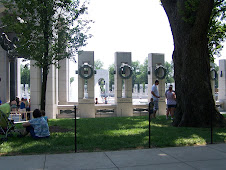
With temperatures around 100 degrees and humidity high, it wasn’t a good time for walking around the Washington National Mall, but I did make time and find the energy for a short trip to the World War II Memorial. It’s beautiful, and I certainly encourage you to make sure you or your relatives who served in World War II are listed in its registry. The link is listed with all the other web links on this blog.

Monday, May 19, 2008

Earl Carmickle


In late fall of 2004, I sent my first large mailing (more than 100 letters) to men who had served in the 101st Cavalry. Out of more than 1,600, it was a small percentage, but it was a start. Earl Carmickle was one of the first to respond.

In the first paragraph of his letter, he told about a mortar shell that went off in his face. “I was treated the same day, but never got my Purple Heart,” he wrote. “My daughter tried, and she got proof I was on duty when hit, but it was denied. Our house burned years ago, and destroyed a lot of my Army records.”

In a Christmas card sent a few months later, he mentioned the Purple Heart again. It was clearly important to him.

Several months later I called Carmickle, and he shared some of his memories of the war. One of the stories he told was of Hill 283, which had been a major obstacle for the 101st just before they crossed the Saar River into Germany.

“This escape trench ran to the tallest hill in the area,” said Carmickle, “and that whole area was heavily mined. There were dead bodies all over the side of hill, German and American. Once we saw about 40 bodies up a little holler. We’d shovel dirt over the Americans at night to keep the animals away. I suppose someone came and got them after we pushed through. We kept their dog tags with them.”

My son Ted and I thought about his words as we walked through the woods near the area we believed was Hill 283. They sobered us on our journey, and made us respectful of the ground we walked on.


Of the Saar crossing, for which the men had waited more than a month, Carmickle spoke with humor: “I knowed it was coming,” he said. “I was glad when it did. I didn’t like the waiting. I enjoyed being on the move. It’s harder to hit a moving target.”

And Carmickle remembered a night spent in a cemetery near the Rhine. “Our lieutenant wanted to set up in a cemetery,” he said. “He said it would be safe there – the Germans wouldn’t fire on a cemetery. We were in the middle of setting up when an artillery barrage started – right there in the cemetery. That lieutenant was wounded in both legs.”

It was war, and the men didn’t only find death in the cemetery. “One night when it was real cold,” he said, “we entered a village that had been bombed pretty bad, and the buildings were still burning. Our sergeant told us to go into one of the houses – the roof had been flown off – and sleep. ‘At least,’ he said, ‘the four walls will keep the wind off of you.’ We bedded down on the floor. We never slept in a bed, since there were a lot of booby traps left in the villages: mines, trip wires, that kind of thing. We woke up in the morning and saw there was a woman in the bed. She was dead, probably killed in the bombing.”

Yesterday – May 18, 2008 – I was reminded of Earl Carmickle. I got an email from Shelia Ramuar – I have learned there are a lot of daughters looking for ways to honor their fathers who served in World War II, and Shelia is one. She told me to check a forum on Ancestry.com. Someone was looking for a veteran of the 101st Cavalry named Grady Collins. There, I found posts written by Earl Carmickle’s daughter, Jeannette Carmickle Walsh , dating back to 2002. She was looking for Collins in the hope he could testify that her father had been wounded, and he could finally get his Purple Heart.

“Maybe you can help her find someone,” Shelia said.

I knew I couldn’t help her find Grady Collins. The Grady Collins she was looking for had died in 1945.

“I lost one of my best friends,” John Almond had said of the day Grady Collins died. “We were up on a hill facing down into the town. We had a little machine gun nest there, and at night we’d pull back and stay in the little houses along both sides of the stream. We had mined the path with a trip wire, and one night I looked down and saw the tail of my overcoat dragging on that wire. I froze and lifted my coat.”

Almond cleared the wire that time, but, a few days later, his friend, Grady Collins wasn’t so lucky.

“Grady, he was from Gainsville,” said Almond, “was coming in one night and forgot about the trip wire, I guess, and set off the mine. I rode with him to the aid station. He didn’t make it.”

The man Carmickle had hoped might confirm that he had been wounded had died on February 25, three days after Carmickle was wounded. Carmickle’s lieutenant, 2nd Lt. Charles Pierce, who would have requested the Purple Heart, died the same day as Collins.


On the afternoon of February 25, Lt. Pierce and 2nd Lt. Alfred Kupferschmit, a member of an interrogation team, were with a recently captured prisoner of war, searching for weapons the German had thrown into the woods. Near the bottom of a hill, they met up with other members of the 116th: 1st Lt. Robert Schafer, S/Sgt. Walter Mennel, and Pvt. Earl Geiger, all of Troop C; and S/Sgt. John Schnalzer, Troop A. At the base of the hill, a concentration of mortar fire fell all around them. The blast killed 2nd Lt. Pierce instantly. Also killed that day were Lt. Schafer and S/Sgt. Mennel.

Complicating matters even more, Carmickle was wounded the same day as the squadron’s commanding officer, Lt. Col. Hubert Leonard, who spent the next few weeks in England recovering from his injuries.

In her post, Jeannette had written that her father remembered Grady Collins as a friend, but they had lost touch. Carmickle had told me that he lost track of several of his friends in the confusing days at the end of the war.

“I tried to stay in touch with my friend [Larry] Hayden,” he said, “but when I first came home, my mother had cancer. I got a Red Cross leave to be with her, and when I returned to base, I had missed everyone. They were gone. I had meant to get all their addresses.”

Carmickle went back to Arkansas after the war. He held different jobs, cutting timber for awhile, and then working in construction in Ohio. “I worked on some big buildings in Columbus,” he said.

Although they lost touch for awhile, he eventually did find Hayden, for whom Carmickle named his first son. “Hayden had gone home to Illinois, and he died in the 1960s,” Carmickle said.

"My dad, my hero, died February 21, 2007,” wrote Jeannette Carmickle Walsh. “I tried to get his Purple Heart issued; I worked for over 10 years, calling, writing, searching, and he still got turned down. I placed a Purple Heart ribbon in his casket, because he should have gotten it from the Army. It was the one thing he wanted before he died.”